
 +55 12 39 33 50 00


Smart Pneumatic Conveying: Where Reliable Material Handling Meets Intelligent Automation
How intelligent valves, precision feeding and connected dust collection are reshaping modern bulk solids handling.
Abstract
As plant owners accelerate investment in automation, pneumatic conveying is evolving from a simple transfer utility into a strategic process discipline. Whether operating in dilute phase for versatility, dense phase for gentle product handling, or vacuum mode for compact dust-free convey, modern systems must combine conveying efficiency with digital control, predictive diagnostics and energy optimisation. Drawing on WAMGROUP’s expertise in flow interception valves, conveying systems and dust filtration technology, this article shows how TOREX Diverter Valves, Blow-Through Rotary Valves and WAMAIR Vacuum Dust Collectors support intelligent conveying architectures with higher throughput, reduced downtime, improved traceability and lower total cost of ownership.
In today’s competitive bulk solids industries, pneumatic conveying systems are expected to do far more than transfer material from one point to another. Across sectors such as food, plastics, chemicals, building materials and animal feed, the market requires conveying solutions that support flexible production, recipe automation, predictive maintenance and energy optimisation.
This evolution is transforming pneumatic conveying into an intelligent process infrastructure—one where valves, feeders and dust collection units interact with the plant’s digital control environment to enhance productivity and reliability.
WAMGROUP’s integrated technology portfolio is designed precisely for this scenario, combining robust performance in demanding operating conditions with compatibility for modern automation strategies.
Automated Material Flow Direction for Flexible Production
In multi-line plants, material diversion flexibility is fundamental to operational efficiency. Diverter valves must switch reliably between destinations such as silos, mixers, weigh hoppers or packaging lines, often under continuous duty and with frequent recipe changes.
The TOREX range of Diverter Valves provides dependable product deviation for pressure and vacuum pneumatic conveying systems across the full range of powders and granules. Designed for excellent sealing performance and long service life, the range supports everything from standard conveying line switching to high-cycle automated applications.
Integrated into PLC-controlled architectures, TOREX valves allow automatic route selection based on batch sequence, storage levels or downstream line availability. This reduces manual intervention while improving process repeatability and minimising cross-contamination risks.
For plant operators, this means faster product changeovers, improved traceability and the flexibility required for smaller, more customised production batches.

Precision Feeding Meets Intelligent Control
In many dilute phase conveying applications, the ability to maintain stable particle suspension at optimised air velocity is essential for reliable transfer over short to medium distances. Here, precise solids feeding and adaptive speed control become critical to preserving throughput while limiting wear and energy use.
Stable pneumatic conveying starts at the feed point. Inconsistent product introduction can compromise pressure balance, increase line wear and reduce overall system efficiency.
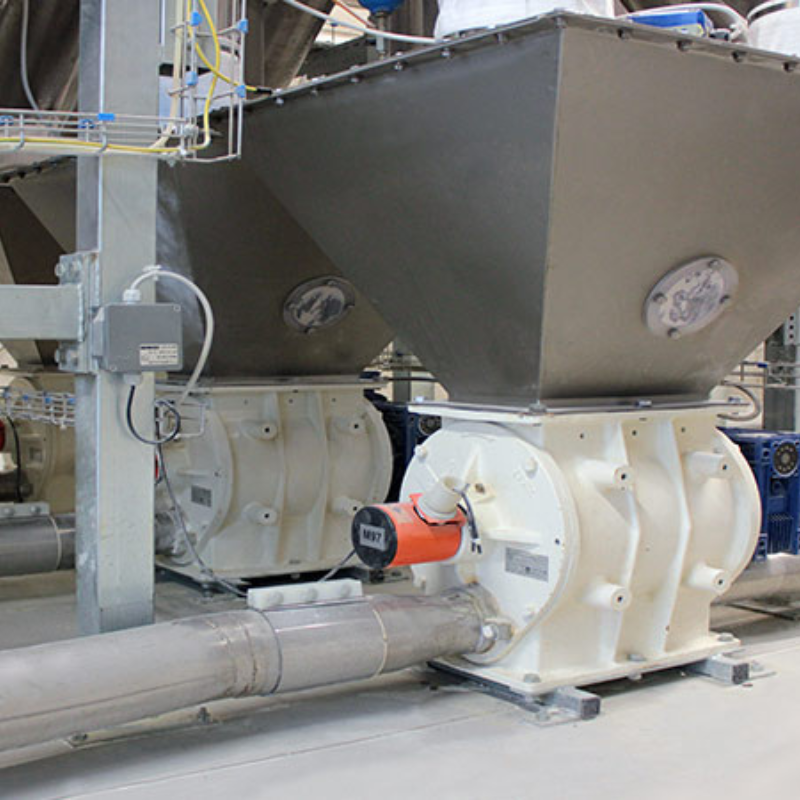
The RVS Blow-Through Rotary Valve is specifically engineered to feed powders and granular materials directly into pneumatic conveying lines with highly repeatable performance. Its compact, robust design and easy maintenance accessibility make it particularly suitable for continuous industrial service.
When combined with variable-speed drives, pressure transmitters and adaptive control algorithms, the RVS becomes a key enabler of smart conveying. Rotor speed can be dynamically adjusted according to line pressure, solids loading ratio or downstream consumption demand, maintaining optimum conveying conditions in real time.
This intelligent feeding approach helps plant managers reduce energy consumption, minimise blockage risk and preserve consistent throughput even under variable production loads.

Connected Dust Collection for Predictive Maintenance
Vacuum conveying remains one of the most compact and process-safe solutions for short-distance transfer, especially where multiple pick-up points feed a single receiver. In these systems, efficient dust filtration and negative-pressure integrity are essential not only for cleanliness, but also for stable automation performance.
In negative-pressure conveying systems, dust collection is an integral part of process continuity. Efficient air-solid separation protects the vacuum source, supports environmental compliance and prevents performance degradation.
The WAMAIR Vacuum Dust Collectors are specifically developed for vacuum pneumatic conveying systems, offering compact, insertable filtration directly within the process layout. Their polygonal design is ideal for installations where footprint optimisation is essential.
The real advantage emerges when WAMAIR units are integrated with differential pressure monitoring, automatic filter cleaning cycles and central maintenance dashboards. Operators can continuously monitor filter condition and anticipate service needs before airflow performance declines.
This predictive maintenance feature reduces unplanned downtime and extends the service life of filters, thereby directly helping to reduce maintenance costs and increase plant availability.

Building the Intelligent Conveying Architecture
Beyond individual components, the market is increasingly moving towards conveying systems that behave as connected process assets. The integration of sensors, differential pressure monitoring, variable-speed drives and PLC communication via Ethernet-based protocols enables remote diagnostics, faster commissioning and data-driven maintenance planning.
For plant engineers, this means pneumatic conveying can now support advanced automation strategies such as recipe-driven line switching, adaptive solids loading control and condition-based service intervals—bringing bulk solids handling fully into the Industry 4.0 environment.
The convergence of mechanical reliability and digital control is redefining best practice in pneumatic conveying.
By combining automated routing through TOREX Diverter Valves, precision feeding via RVS Blow-Through Rotary Valves and smart de-dusting with WAMAIR Vacuum Dust Collectors, WAMGROUP enables plant designers to build conveying systems that actively support operational intelligence.
The result is a conveying architecture that delivers not only efficient material transfer, but also higher visibility, improved decision-making and long-term process resilience.
For manufacturing companies investing in automation, pneumatic conveying is rapidly becoming a strategic platform for competitiveness.
And with WAMGROUP, that platform is built on reliability, flexibility and smart integration.


